

Equipping a spare room or studio often leads to one major debate: Daybed vs. Sofa. While both save space, they prioritize different needs.
A daybed is fundamentally a bed frame designed to look like seating. A sofa is built specifically for ergonomic sitting.

To avoid buyer’s remorse, follow this simple design rule:
- Choose the Daybed if the room is primarily for sleeping (guests or naps).
- Choose the Sofa if the room is primarily for sitting (TV or socializing).
The Cheat Sheet: At a Glance
Got no time to read? Here’s the raw data on how they stack up side-by-side .
What is a Daybed?

A daybed is a hybrid piece of furniture. It looks like a bench but works like a bed. Structurally, it is a three-sided frame with a headboard, a footboard, and a back panel that holds a mattress.
The “Real Mattress” Advantage
The main benefit of a daybed is the mattress. It uses a standard twin mattress (approx. 39 by 75 inches).
Sleeper sofas often use thin folding pads or springs. A daybed gives you the same support system as a regular bed. You can pick your preferred firmness, like memory foam or innerspring, without losing comfort.
Pros of a Daybed
- Better Sleep: You sleep on a real mattress, so there is no metal bar digging into your back.
- Zero Setup: There are no heavy mechanisms to unfold. It is always ready for a nap.
- Lower Cost: The design is simple. You do not pay for complex moving parts, which keeps the price down.
Cons of a Daybed
- Small Size: Most daybeds are only Twin or Twin XL size. This fits one person comfortably, but not a couple.
- The “Depth Dilemma”: This is a major ergonomic issue. A twin mattress is about 39 inches deep. A normal sofa seat is only 20 to 24 inches deep.
Ergonomic Note: If you sit all the way back, your feet likely won’t touch the floor. To sit comfortably, you need large bolster pillows behind you to shorten the seat depth. Without them, you are lounging, not sitting.
What is a Sofa (and Sleeper Sofa)?

A sofa is built for sitting. It uses a sturdy frame and cushions designed for support. A “sleeper sofa” is simply a couch that hides a fold-out mattress inside.
Designed for Comfort
The structure makes the difference. Standard sofa seats are 20 to 24 inches deep. This lets you sit with your back against the cushions and your feet flat on the floor. It provides the lumbar support that daybeds lack.
The Aesthetic Factor
Sofas look polished. In a living room, a sofa anchors the space and looks “finished.” A daybed can look out of place here, often making a living room feel like a bedroom.
Pros of a Sofa
- Better Posture: The backrest and armrests support you while you sit upright.
- Larger Beds: Sleeper sofas often fold out into Queen or King sizes. This is essential for hosting couples.
- More Styles: You have endless choices, from large L-shaped sectionals to sleek modern designs.
Cons of a Sofa
- Heavy: Sleeper sofas have heavy metal frames. Moving them requires two strong people.
- Mechanical Issues: The fold-out parts can break, rust, or squeak over time.
- Thin Mattresses: To fold up, the mattress must be thin. Guests may feel the metal bars underneath them.
The Comfort Duel: Sitting vs. Sleeping

Let’s get physical. Which one actually feels better to use?
Round 1: Sleeping
Winner: Daybed
Daybeds win easily. You sleep on a real, thick mattress. This supports your spine and prevents back pain.
Sleeper sofas often rely on thin foam pads. Unless you buy a luxury model, guests can often feel the metal bars pressing into their backs.
Round 2: Lounging
Winner: Tie
“Lounging” means relaxing, reading, or napping.
- Daybeds are perfect for curling up. The deep space creates a cozy “nest.”
- Sofas are better for movie watching. You can lean back against the cushions while keeping your feet on the floor.
Round 3: Formal Sitting
Winner: Sofa
If you want to sit and chat, the sofa wins. The seat depth lets you sit upright with your feet flat on the ground.
Daybeds are hard to sit on properly. The mattress is too deep, so your back cannot reach the wall. You need a stack of pillows just to sit up straight.
Room-by-Room Suitability Guide
Living Room
Best Choice: Sofa

The living room is for hosting. A sofa looks polished and invites people to sit. A daybed often looks out of place here, making the space feel like a bedroom. Stick to a sofa for your main shared area.
Guest Room / Home Office
Best Choice: Daybed
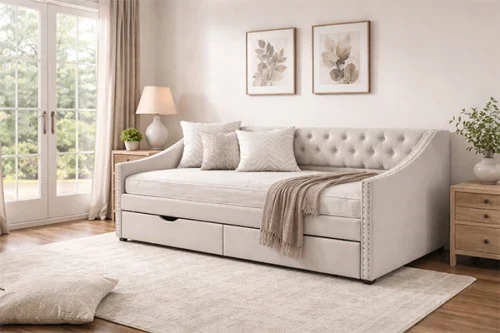
These rooms need flexibility. A daybed pushes flush against the wall, leaving floor space for a desk or yoga mat. A sleeper sofa is bulky and eats up room even when folded.
Studio Apartment
Best Choice: The Hybrid Approach

In a studio, this might be your only bed.
- Solo Dwellers: Choose a daybed. A real mattress is essential for nightly back health.
- The Trundle Trick: Get a daybed with a trundle (a pull-out drawer with a second mattress). This doubles sleeping space for guests without losing floor space.
3 Things to Check Before You Buy (Don’t Skip This)

#1. Check the “Open” Size
Do not just measure the couch. You must measure the bed when it is fully open.
- Daybeds: The footprint is static. It never changes size. If it fits now, it fits always.
- Sleeper Sofas: These expand significantly. A sleeper sofa might fit against the wall, but when you pull it out, it might block the doorway or hit your TV stand. Always measure the room with the bed fully extended.
#2. Frequency of Use
Be honest about how often people will sleep on it.
- Daily Sleeper: If this is for you or a long-term guest, get a Daybed. Your back needs the support of a real mattress.
- Occasional Guest: If you only host family for the holidays, a Sleeper Sofa is fine. The comfort trade-off is worth it to have a nice sofa for the other 360 days of the year.
#3. The Sheets Factor
This is a small annoyance that owners often forget.
- Daybeds: They use standard Twin sheets. You can buy them anywhere, and you likely already own some.
- Sleeper Sofas: These often have odd dimensions. They are usually thinner and shorter than standard mattresses. Standard sheets may bunch up or slide off, forcing you to buy specialized “sofa bed sheets.”


 English
 Spanish
 Portuguese
 Russian
 Arabic
 Japanese
 Korean
 German
 French
