

Two acronyms. Completely different worlds. FF&E (Furniture, Fixtures, and Equipment) covers the durable, semi-permanent assets that give a property its physical identity: its bones, its character, its visual signature. OS&E (Operating Supplies and Equipment) is the operational layer, the consumables and tools that keep the whole thing running day to day. Used together correctly, understanding what is FF&E and OS&E is honestly foundational to any hospitality or commercial development that wants to open on time, on budget, and actually function once guests walk through the door.

The Basics of FF&E and OS&E
What is FF&E? (Furniture, Fixtures, and Equipment)

Walk into any well-designed hotel lobby and ask yourself: what actually makes this space feel intentional? The answer is FF&E. Furniture, Fixtures, and Equipment. These are the tangible, long-lasting assets that shape a property’s physical environment: custom lobby seating, bedroom headboards, reception desks, statement chandeliers, built-in cabinetry. In international commercial and hospitality projects, every FF&E piece is chosen to carry the brand’s identity forward, built to last years before anyone seriously talks about replacement.
Costs add up fast. In new construction, FF&E typically accounts for 8% to 12% of total project costs. And because so many of these items are custom-manufactured, requiring shop drawings, FF&E specification approvals, and highly specialized production, lead times can stretch 12 to 16 weeks before ocean freight is even part of the conversation.
What is OS&E? (Operating Supplies and Equipment)

OS&E is less glamorous. Much less. But try opening a hotel without it.
These are the items guests use and staff depend on every single day:
- Bed linens and towels
- Glassware and kitchen tools
- Housekeeping carts
- Staff uniforms
Unlike FF&E, OS&E is not designed for longevity. It cycles rapidly and needs continuous replenishment based on carefully tracked par levels.
OS&E accounts for roughly 4% to 7% of total development costs, a smaller slice than FF&E, but operationally it is non-negotiable. A failure in OS&E procurement can halt an opening entirely. No clean towels. No functioning kitchen equipment. No basic guest room supplies. No hotel.
The Shake Test: A Simple Way to Tell the Difference
Understanding the difference between FF&E and OS&E becomes much easier with one industry analogy that has been floating around for years, and honestly, it works. Imagine turning a building upside down and shaking it. Permanent structural elements stay fixed: the walls, floors, and ceilings. Everything that falls out is either FF&E or OS&E. The distinction between those two comes down to durability and purpose. If it shapes the space and lasts years, it is FF&E. If it keeps operations running and needs frequent restocking, it is OS&E.
Financial Strategy: CapEx vs. OpEx

Why Misclassifying Costs Ruins Budgets
FF&E is classified as a Capital Expenditure (CapEx). It is a long-term investment. It adds book value to the property and gets depreciated across multiple years. OS&E, by contrast, is typically an Operating Expenditure (OpEx), flowing straight through the monthly profit-and-loss statement as a recurring cost of doing business.
Here is where things get messy. The boundary is not always clean. Standard OS&E items like linens and disposable amenities are clearly OpEx. But high-value operational equipment such as commercial-grade storage systems and heavy-duty housekeeping carts can actually qualify as CapEx due to extended lifespan and purchase price. When procurement teams misclassify those items into the OpEx budget, operational funds run dry mid-quarter. Then comes the scramble: last-minute supplies sourced at premium retail prices, monthly margins destroyed, vendor relationships strained. It is an avoidable disaster that plays out more often than it should.
To protect long-term asset value, developers should establish a dedicated FF&E reserve fund from the first day of trading. Industry practice recommends starting that reserve at 2% of annual revenue.
Tax Depreciation and MACRS Guidelines
The IRS allows hotel owners to recover FF&E costs through the Modified Accelerated Cost Recovery System (MACRS) (Source: IRS Publication 946). This framework assigns assets to specific depreciation classes:
- 5-Year Property: Carpets, commercial appliances, and technology equipment
- 7-Year Property: Desks, beds, chairs, and specialized fixtures
Section 179 adds another lever. Businesses can deduct the full purchase price of qualifying FF&E in the year of purchase, up to approximately $1.22 million. Executing a cost segregation study lets developers isolate FF&E from the building structure (39-year property), accelerating early-year deductions and meaningfully improving the project’s internal rate of return. For CFOs and real estate developers, this is one of the most underutilized parts of the entire procurement conversation.
A Direct Factory Perspective on FF&E Procurement

The Advantage of Sourcing Directly from Hotel FF&E Manufacturers
Working directly with hotel FF&E manufacturers cuts out an expensive middleman. Traditional procurement agents charge 10% to 20% of total FF&E value (Source: Procurist 2026 Procurement Agents Guide). Going factory-direct keeps those margins inside the project budget where they belong. Beyond the cost savings, it delivers three practical advantages:
- Specification changes get handled faster, with no agent acting as a relay between the client and the production floor
- Lead time forecasts become more reliable because the information comes straight from the people running the machines
- Quality control throughout the production run is cleaner and easier to document
For buyers focused on global FF&E sourcing, factory-direct relationships also unlock access to custom manufacturing that agents rarely facilitate efficiently. Custom headboards, branded upholstery configurations, bespoke case goods: all of it becomes far more achievable when you are working directly with the people building it.
Managing Bulk Production and Global Supply Chains
Custom hotel furniture manufacturing across international supply chains requires serious planning. Production typically takes 8 to 12 weeks on the factory floor. Add another 4 to 6 weeks for ocean freight transit. That math means FF&E procurement must begin at least 8 months before the property’s target opening date. Not 6 months. Eight.
Lead time management is non-negotiable. Teams must track production milestones, confirm raw material sourcing, and lock in freight bookings early, especially during peak shipping seasons when container space tightens faster than most people expect.
Total Cost of Ownership and Quality Control
Unit price is, frankly, a poor metric for evaluating FF&E. A chair that costs 20% more at purchase but lasts 8 years without reupholstering delivers far better value than a cheaper alternative that degrades in 3. Modern procurement teams evaluate Total Cost of Ownership (TCO) across four key dimensions:
- Durability: How the material holds up under sustained commercial use
- Maintenance requirements: What ongoing upkeep the asset demands over its life
- Replacement frequency: How often the item will need to be cycled out
- Long-term performance: How materials hold up under sustained commercial use over time
Factory-level quality control fits into that equation directly. Pre-shipment inspections, material certifications, and sample approval rounds significantly reduce the risk of receiving non-compliant goods at the job site. Corrections at that stage are not just expensive; they are schedule-breaking.
A Step-by-Step Hospitality Procurement Process
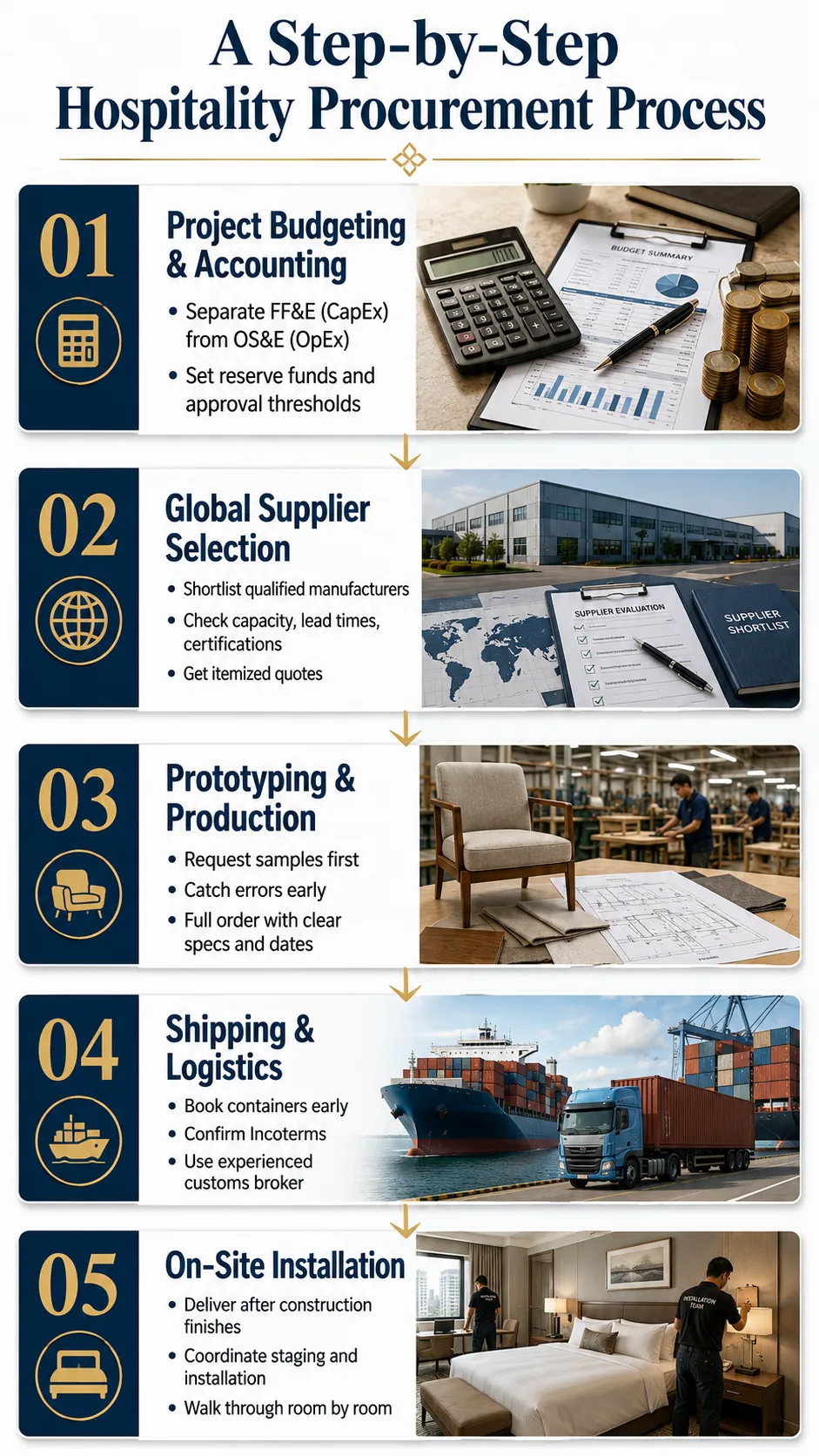
- Project Budgeting and Accounting: Separate FF&E (CapEx) from OS&E (OpEx) in your project budget before sourcing begins. Define reserve fund allocations and establish approval thresholds for both categories.
- Global Supplier Selection: Build a qualified shortlist of manufacturers and suppliers. Evaluate each on production capacity, lead times, sustainability certifications, and commercial project history. Request itemized quotes that separate product cost from freight and packaging.
- Prototyping and Production: Before committing to mass production, request physical samples or a model room build-out. This step catches scale errors, material inconsistencies, and color mismatches early. Once approved, place the full production order with clear FF&E specifications, deposit terms, and milestone dates.
- Shipping and International FF&E Logistics: Secure container bookings early. Confirm Incoterms with the manufacturer to define responsibility for freight, insurance, and customs clearance. Work with a customs broker who has experience handling commercial hospitality goods to prevent port delays.
- On-Site Installation: Time delivery to coincide with construction completion. FF&E should arrive after painting, flooring, and ceiling finishes are done. Coordinate with the site superintendent to sequence room readiness, manage warehouse staging, and supervise white glove installation teams. Conduct room-by-room walkthroughs to document any damage or missing items before project closeout.
Real Commercial Project Case Studies

Supplying a Large-Scale Global Resort
A full-service resort spanning several hundred guest rooms is a coordination exercise unlike almost anything else in commercial procurement. Guest room case goods, lobby seating, poolside furniture, restaurant fixtures, and back-of-house equipment all carry different manufacturing schedules and freight requirements. Getting them to land on site in the right sequence, without stalling active construction, takes real logistical discipline.
On one multi-hundred-room resort project, production was staggered deliberately across three factories to meet phased delivery dates. Case goods shipped first. Soft goods and public area feature pieces followed in the next wave. On-site staging areas were organized by floor, allowing installation crews to receive and sort deliveries without ever disrupting ongoing construction activity.
Custom Seating for an International Office Space
Commercial office projects carry their own FF&E specification demands, and they are not forgiving. A recent international headquarters project required ergonomic task seating with specific fabric grades, custom arm configurations, and exact branded color matching across a 600-seat open-plan environment.
Working directly with the manufacturer made one critical difference. When the client revised the fabric specification late in the process, adjustments happened quickly. No third-party agent adding a communication layer between the design team and the factory floor meant lead times held firm. Revised samples were approved within one week.
Using Software to Automate Procurement

Digital Materials Libraries
Manual FF&E procurement runs on spreadsheets, email chains, and disconnected filing systems. Errors pile up quietly in predictable ways:
- A discontinued item gets ordered because no one updated the spec sheet
- An FF&E specification change never makes it into the purchase order
- A freight booking falls through the cracks between two teams using separate systems
Centralized procurement platforms are built specifically to close those gaps. A digital materials library connects design specifications directly to the procurement team’s purchasing dashboard. When a designer updates a specification, that change reflects immediately in the cost estimate and the order queue. One source of truth. No transcription errors. Fewer administrative hours burned across the full project lifecycle.
Room Prototyping for Multi-Location Brands
For franchise operators and hospitality brands managing multiple properties at once, digital room prototyping tools are genuinely powerful. These platforms let teams build a standardized room template and then automatically calculate FF&E procurement costs across different locations by adjusting for regional pricing and logistics variables.
Rolling out consistent brand standards across dozens of properties simultaneously? What used to take weeks to scope per location now takes hours. FF&E specification compliance is enforced automatically, preventing individual properties from quietly substituting non-approved items that would otherwise erode the brand standard from the inside out.


 English
 Spanish
 Portuguese
 Russian
 Arabic
 Japanese
 Korean
 German
 French
