

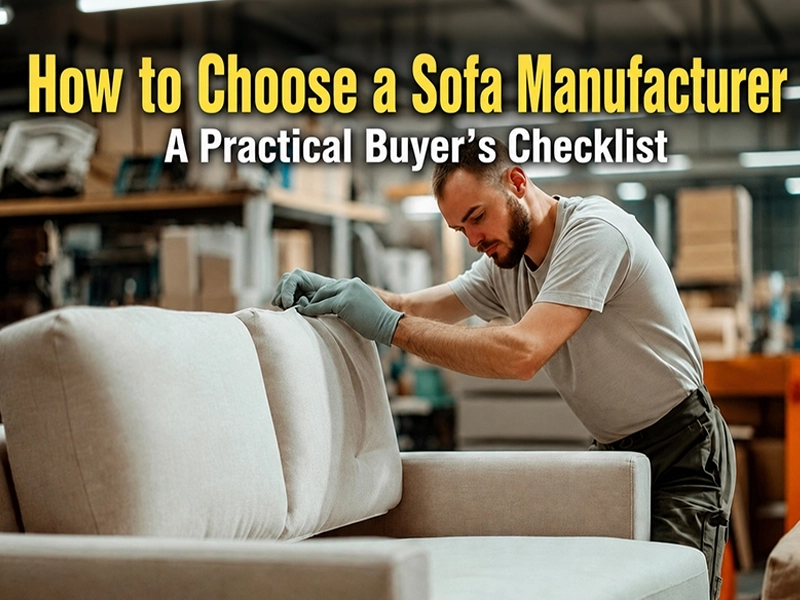
Why choosing the right sofa manufacturer matters

- It affects the product your customers experience every day. A sofa is not judged only by how it looks online. Buyers notice how it feels, how it holds its shape, and whether it still looks good after months of use.
- A good sample does not always mean reliable mass production. The real test is whether the manufacturer can repeat the same quality at scale, from frame strength and cushion resilience to stitching, sizing, and packaging.
- The wrong partner creates problems long after delivery. Delays, hidden defects, warranty claims, and poor after-sales support can quickly turn a promising product into a costly headache.
- The right manufacturer protects your brand promise. A dependable partner gives you more than production capacity. They help ensure every sofa reflects the quality your customers expected when they placed the order.
Define the type of sofa manufacturer you need

Before you compare prices or request samples, get clear on what kind of sofa manufacturer fits your project. A factory that works well for a retail furniture brand may not be the right match for a hotel, interior design studio, or custom sofa line.
Retail, wholesale, contract, hospitality, custom, and OEM suppliers
Different buyers need different strengths from a manufacturer:
- Retail furniture brands need consistent quality, reliable packaging, and repeatable production.
- Wholesale buyers often care most about MOQ flexibility, stable lead times, and clear defect policies.
- Hotels, offices, and contract projects need sofas built for heavy daily use, not just showroom appeal.
- Custom sofa buyers may need flexible sizing, fabric choices, cushion comfort options, and design adjustments.
- OEM brands need a manufacturer that can follow private-label specs, drawings, materials, and branding rules.
Local vs overseas sofa manufacturers
Both options can work, but the risks are different.
- Local manufacturers may offer faster sampling, easier communication, and lower shipping risk.
- Overseas manufacturers may offer stronger pricing and larger production capacity, but they usually require stricter factory checks, quality control, and logistics planning.
The best choice is not always the cheapest one. It is the manufacturer that fits your product, order size, timeline, quality standard, and customer expectations.
See also: China vs Local Sunscreen Manufacturer
Evaluate sofa quality from the inside out

A sofa can look beautiful in a photo and still fail after a few months. The real test is what you cannot see at first glance: the frame, joints, springs, foam, fabric, and stitching. When choosing a sofa manufacturer, ask how the sofa is built before you ask how it looks.
Frame materials and joinery
Start with the frame. This is the part that carries the weight of the sofa every day.
Look for:
- Kiln-dried hardwood, engineered hardwood, or high-quality plywood
- Reinforced corners
- Screws, dowels, glue, or corner blocking
- A frame that feels stable, not light or wobbly
Be careful with:
- Thin boards
- Poorly supported corners
- Frames that twist, creak, or shift when moved
Suspension systems
The suspension sits under the cushions and supports the seat. Common options include sinuous springs, webbing, and hand-tied springs.
A good suspension system should:
- Feel even from side to side
- Offer firm support without sagging
- Stay quiet when someone sits down
- Be securely fixed to the frame
- Be tested for daily use
The name of the spring system matters less than how well it is installed.
Foam density, firmness, and cushion construction
Foam density and firmness are not the same thing. Density affects how long the cushion keeps its shape. Firmness affects how soft or supportive it feels.
Ask the manufacturer for:
- Foam density
- Firmness level
- Cushion layering details
- Whether the foam is wrapped with fiber, down, or another material
For everyday seating, higher-density foam or layered cushions often perform better than soft, low-density foam that flattens quickly.
Fabric, leather, stitching, and upholstery finish
The outside finish shows how carefully the sofa was made.
Check for:
- Tight, smooth fabric
- Even leather color and texture
- Straight stitching
- Flat seams
- Clean corners
- No loose threads, puckering, or uneven panels
Small details matter. They often reveal whether the manufacturer has strong quality control or is simply rushing production.
Audit the factory’s production process

The sample might look perfect on your desk, but the real question is whether the factory can repeat that same quality across 50, 500, or 5,000 sofas. That is where the production process matters.
Design and sampling
Before production begins, the manufacturer should lock down every key detail:
- Sofa size
- Frame structure
- Fabric code
- Cushion feel
- Stitching style
- Leg finish
- Label placement
- Packaging method
Treat the approved sample as the rulebook for the full order, not just a nice reference photo.
Cutting, sewing, frame assembly, and upholstery
Strong production has a steady rhythm. Fabric is cut cleanly. Sewing lines stay straight. Frames feel solid, not loose or hollow. During upholstery, fabric or leather should sit smooth and tight, with clean corners and no awkward wrinkles.
Inline and final quality inspection
Quality control should happen while the order is being made, not only when everything is packed. Inline checks catch issues early. Final inspection confirms the sofa matches the approved sample in size, comfort, appearance, stitching, stability, labeling, and packaging.
Check compliance, flammability, and chemical-safety requirements

Compliance may not be the most exciting part of choosing a sofa manufacturer, but it can save you from returns, customs issues, and unsafe products. Rules depend on where the sofa will be sold, so ask for documents that match your target market, not a generic certificate.
U.S. CPSC 16 CFR Part 1640
For U.S. sales, covered upholstered furniture must meet the federal flammability standard under 16 CFR Part 1640. The labeling rule applies to upholstered furniture manufactured, imported, or reupholstered on or after June 25, 2022. Ask to see the permanent label before production starts.
California TB117-2013 and flame-retardant disclosure
California adds another layer. TB117-2013 focuses on smolder resistance, while SB 1019 requires labels to show whether flame-retardant chemicals were added. This is especially important for brands selling into California.
Foam, fabric, and sustainability certifications
For foam, CertiPUR-US can support low-emission claims, but it certifies flexible polyurethane foam, not the whole sofa. Certified foam is tested for low VOC emissions below 0.5 ppm.
Fabric, wood, and sustainability claims need their own proof, such as abrasion tests, FSC documents, or BIFMA-related reports.
Compare lead time, MOQ, capacity, and logistics

Lead time can make or break a sofa order. Before choosing a sofa manufacturer, ask for a realistic timeline, not just the fastest possible answer.
Ask about:
- Sampling time: How long does it take to make and revise a sample?
- Production time: How many days are needed after sample approval?
- Inspection time: When does quality control happen?
- Packing and shipping time: How long before the order leaves the factory?
- Peak season delays: What changes when the factory is fully booked?
MOQ matters too. A low MOQ helps you test a new design with less risk. A larger MOQ may reduce unit cost, but it also ties up more cash and warehouse space.
Production capacity should match your growth plan. If your first order sells well, the factory should be able to handle repeat orders without rushing or cutting corners.
For logistics, look beyond shipping price. Check carton strength, corner protection, moisture control, loading methods, and who handles damaged goods.
Calculate total landed cost and supplier risk

Cheap unit pricing can look tempting, but it rarely tells the full story. When comparing sofa manufacturers, calculate the total landed cost before making a decision.
Include the sofa price, sample fees, packaging, inland transport, ocean or air freight, customs duties, warehousing, inspection fees, and possible repair or replacement costs. Small details can change the real profit margin fast.
Supplier risk matters too. Late production, poor packaging, weak quality control, or unclear defect policies can cost more than a higher upfront price from a better factory.
For a smarter comparison, look at:
- Total cost per delivered sofa
- Defect and return risk
- Lead time reliability
- Packaging protection
- Warranty support
The best manufacturer is not always the cheapest. It is the one with the most predictable cost, quality, and delivery.
Review reputation, references, and after-sales support

Reputation shows up when something goes wrong. Before choosing a sofa manufacturer, look beyond polished photos and showroom samples.
Ask for:
- Buyer references: Speak with customers who placed repeat orders.
- Project examples: Review sofas made for similar markets, budgets, or order sizes.
- Delivery history: Check whether the factory usually ships on time.
- Quality consistency: Ask if larger orders matched the approved sample.
- Defect handling: Find out how the manufacturer responds when problems appear.
- After-sales support: Confirm warranty terms, spare parts, repair guidance, and claim response time.
Strong manufacturers do not disappear after shipment. They stay accountable, solve problems, and help you protect your customers’ trust.
Final sofa manufacturer scorecard

Use this scorecard before you commit to any sofa manufacturer:
- Product fit: Matches your style, market, and order size.
- Build quality: Strong frame, durable foam, clean upholstery.
- Proof: Provides material specs, test reports, and certificates.
- Factory control: Shows clear sampling, production, and inspection steps.
- Compliance: Meets safety and chemical rules for your market.
- Logistics: Offers realistic lead times, packaging, and shipping support.
- Service: Handles defects, warranty claims, and repeat orders well.
Choose the supplier with the best overall balance, not just the lowest quote.
Looking for an OEM/ODM Sofa Manufacturer?

If you are looking for a sofa manufacturer for private-label, wholesale, hospitality, or commercial projects, we would be happy to help. At SUNSGOODS, we provide OEM and ODM furniture manufacturing for buyers who need custom sofas built around their own market, design, and brand requirements. We can support custom dimensions, materials, colors, components, branding, and packaging. With 35 years of furniture manufacturing experience, 12 automated production lines, and certifications including BIFMA, ISO, FSC, CE, BSCI, SGS, BV, TUV, ROHS, and Intertek, we aim to make sofa sourcing more reliable, flexible, and project-ready.


 English
 Spanish
 Portuguese
 Russian
 Arabic
 Japanese
 Korean
 German
 French
