


Is Importing Mattresses from China Worth It?

Yes, it is beneficial to import mattresses from China for international buyers looking for reliable supplies, design flexibility and wholesale bulk prices. China already has a well-developed mattress supply chain for foam, pocket spring, hybrid, latex and mattress in a box items.
This option is especially suitable for:
- Retailers expanding their bedding range
- Wholesalers supplying local furniture markets
- Hotel and apartment project buyers
- E-commerce and private-label brands
- Importers looking for OEM/ODM support
The key benefit is flexibility. The customer can specify the size, firmness, fabric, quilting, logo, packaging, and components. This ability to cater for specific markets is a major benefit.
Of course success does take effort and a shrewd approach; buyers will need to be aware of supplier experience, product specifications, test reports, import duties and shipping schedules before they commit to buying in large quantities. A low factory price is a good start, but that’s not the objective. Consistent, compliant, readily available quality for the long term is the main goal.
Understand Your Target Market Requirements Before Importing
Check the regulations for your destination market before ordering and importing mattresses from China. Compliance with Mattress Regulations varies from region to region. By verifying the above issues upfront, you will eliminate delays, testing failures, relabelling and associated extra costs.
Tip: Ensure you have confirmed all target-market needs with the supplier before sample approval and bulk production. They need to be clear of target market needs from the early stages to ensure they have access to all relevant materials, labeling, and test paperwork.
Mattress Types You Can Source from China

Mattress factories in China can manufacture many types of mattresses suitable for retail stores, wholesale businesses, hotel chains, medical facilities and private label operations. What’s the right mattress for your business will come down to your market, the price range you’re aiming for, the level of comfort and how you plan to ship it.
Common mattress types include:
- Foam and memory foam mattresses: Work well for E-commerce, roll-pack shipping, and to get pressure relief position.
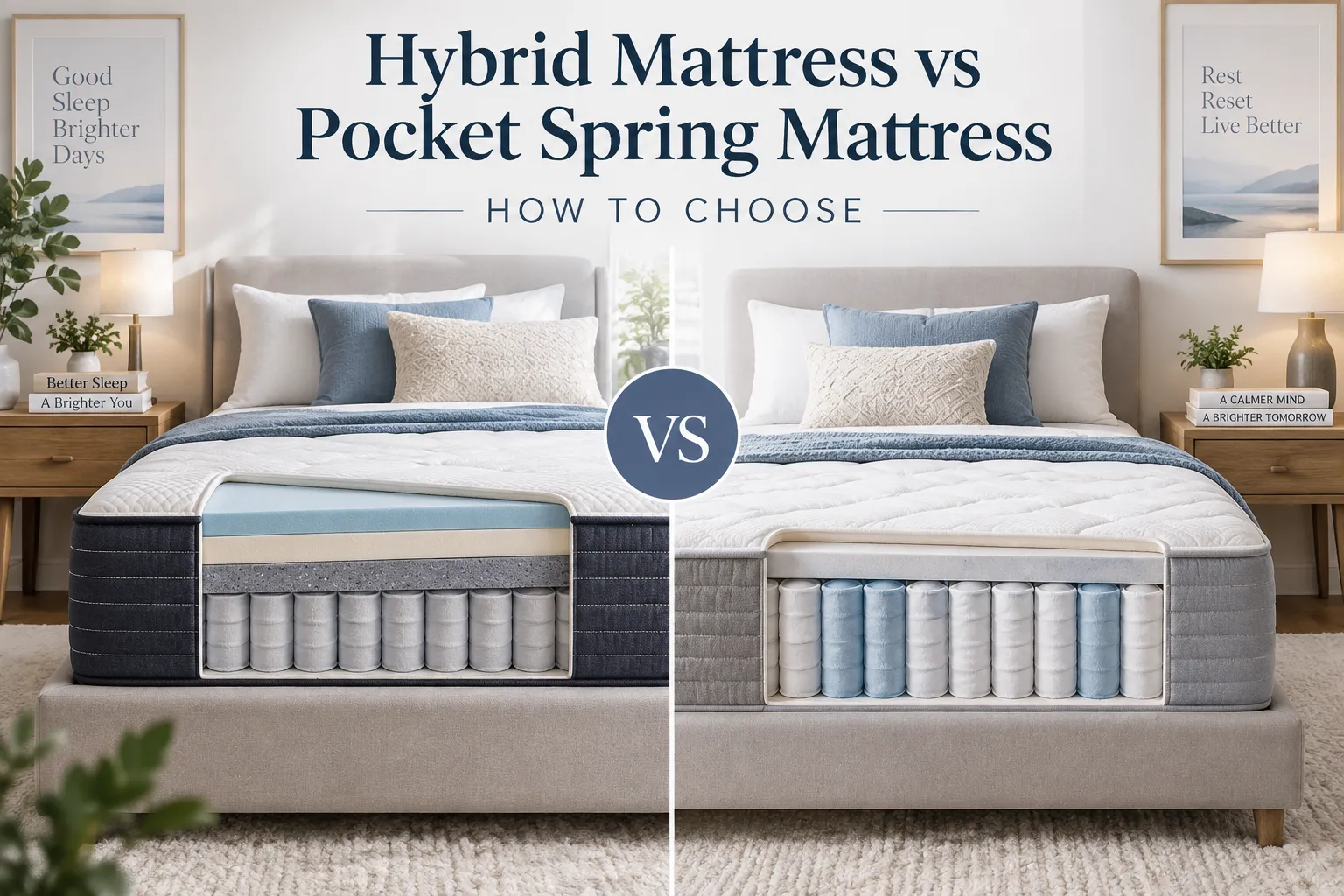
- Pocket spring and innerspring mattresses: Work well for traditional retail and for the customer requiring sturdy support and air flow.
- Hybrid mattresses: Designed as a higher price point line combining foam, fabric, and springs.
- Latex mattresses: Often incorporated into the premium or natural comfort line.
- Pillow top and euro top mattresses: Used in hotel, high-end retail, and show room environments.
- Mattress-in-a-box products: Designed to be compressible, carton packed and sold on-line.
- Project mattresses: Designed for hotels, dormitories, apartments, medical offices, and high volume contract work.
How to Choose the Right Mattress Specifications

Selecting suitable mattress specifications is one of the crucial processes before mass production. Clear specifications help the factory monitor cost, comfort, quality and compliance.
Begin with the target market size standard. The standard size Queen may not be identical for the U.S, UK, EU or Australia. Establish accurate length, width and height in inches or centimeters.
Next, define the comfort structure:
- Firmness level: soft, medium, firm, or custom rating
- Foam density: affects support, durability, and cost
- Spring system: Bonnell, continuous spring, or pocket spring
- Fabric: knitted fabric, jacquard, bamboo, Tencel, or cooling fabric
- Quilting: plain, patterned, pillow-top, or euro-top
- Edge support: foam encasement or reinforced spring border
Confirm any required materials for your market. Is fire-retardant barrier material, low-VOC foam, certified fabrics, or a certain standard for glue standards? Make sure it complies with local regulations and what your branding states.
The package is also covered by the specification. For the mattress delivered through e-commerce, it can be vacuum packed, rolled up, with color box and drop-tested cartons. A hotel mattress can be shipped flat due to consideration for keeping the shape and supporting its edge.
Tip: Ask for a written specification sheet before you inquire about prices. This ensures a level playing field between the suppliers and there will be no difference between the quality of a sample and the batch
Where to Find Mattress Manufacturers in China

There are multiple strong mattress production bases in China. Different bases have their own advantages concerning raw materials, labor power, industry chain, and export experience.
Key manufacturing regions include:
- Guangdong: Excellent for foam, hybrid, upholstered beds and export oriented furniture manufacturing capacity.
- Zhejiang & Jiangsu: Suitable for spring mattresses, textile materials and high volume manufacturing.
- Shandong: Suitable for manufacturing at competitive prices, export production capacity is expanding.
- Hebei and other regions: Suitable for simpler models, volume orders and price oriented markets.
To get suppliers you can attend trade fairs, sourcing on B2B platforms or through sourcing agents, direct to the factories website. If placing a large order on a long term basis, direct to the factory is much preferable than simply selecting on price alone on the web.
Key points to compare with manufacturer: production capability, exported to markets, OEM/ODM experience, certificates and quality of samples, prompt reply speed. Good supplier should have knowledge of your market and technical support prior to quoting.
How to Vet a Chinese Mattress Supplier

A supplier should also be something else than just cheap. Always, before making the order in large quantities, try to find out if the firm you’re cooperating with is a factory, or a trading company, or just a reseller. A real factory can prove production line, working machinery and workers, warehouse and packaging area.
In OEM/ODM mattress projects, inquire about design support, sample development, material selections and what kind of customization is possible. A good mattress supplier will offer assistance in modifying mattress firmness, foam density, spring systems, fabric, quilting,logo, labels and packaging.
Review these points before approval:
- Certifications and test reports: Check if documents match your target market.
- Export experience: Ask which countries they supply and what mattress types they export.
- Production capacity: Confirm monthly output, lead time, and peak-season limits.
- QC system: Review material checks, in-line inspection, final inspection, and loading control.
- Communication: Test response speed, technical knowledge, and problem-solving attitude.
Request a factory audit or third party inspection if possible. This ensures that the equipment, production line, warehousing and packaging line are up to standard.
An excellent mattress supplier does more than manufacture products. They should help you manage risk, quality and supply stability.
How Much Does It Cost to Import Mattresses from China?

However, the cost of importing a mattress from China isn’t just about the factory price. Buyers need to look at FOB price versus landed cost before deciding.
FOB price usually includes mattress, standard packaging and shipping fee to China port. The landed cost includes all cost to get to your warehouse or sales channel.
Main cost factors include:
- Mattress type, size, thickness, and structure
- Foam density, spring system, fabric, and quilting
- Order quantity and MOQ
- OEM/ODM design, logo, label, and packaging
- Product testing and certification
- Sea freight, destination fees, duties, and taxes
- Customs broker and local delivery fees
Unit price is also impacted by MOQ. It could allow for savings on material, setup, packing and freight cost per mattress when ordering a larger volume. However, it puts more pressure on the stock levels. It may be better to try an order before placing larger volumes if it is the first time.
Here is a simple example:
Remember to always figure out the total landed cost rather than the unit cost being quoted.
Quality Inspection Checklist Before Shipment

The pre shipment inspection is used to ensure that the bulk mattresses are consistent with the agreed sample and the purchase order. The inspection should be performed before final payment and loading into the container.
Key inspection points include:
- Sample approval: bulk production compare with approval sample for dimension, firmness, height, fabric, color, quilting and labeling, etc.
- Material inspection: check foam density, spring structure, fabric quality, glue state, zipper, FR barrier and other certified material need, etc.
- Production inspection: check mattress dimension of length, width, height, comfort feel of mattress, side support, stitching, quilting and overall structure.
- Packaging inspection: check compressed size, quality of rolling, carton strength, bar-code, shipment marks, caring labels and user manual.
- Final loading check: check carton quantity, container condition, moisture proof, packing direction and product images..
Tip: Request a report from inspection that includes photos, dimensions, defects found (as well as successful items), and pass/fail results. This establishes a common knowledge base for both the buyer and the supplier before the goods are shipped from the facility.
Shipping Mattresses from China

Because mattresses are large items, your shipping strategy is a key part of your costs and product condition. The best strategy is dependent on your mattress style, order size, packaging technique and target market.
Most export mattresses are shipped in one of two ways:
- Flat-packed: Best for deluxe mattresses, hotel mattresses and those with thick springs. Shape protection and increased container use.
- Compressed and roll-packed: Best for foam, hybrid, mattress-in-a-box products. Reduced container use and less costly freight charges.
Bulk orders typically benefit from FCL shipping because it is both cost effective and secure. If the orders are small and for a trial run, LCL shipping could be viable but poses the risk of additional handling.
Sea freight is the most frequently used and affordable method of transport. Rail freight or combined transport (multimodal) may be suitable for European or landlocked markets. Air freight is rarely an option due to the bulk of mattresses.
Make sure Incoterms are confirmed when placing the order, options available: EXW, FOB, CIF, DAP, DDP.
Before loading; confirm box strength, moisture proofing, shipping marks, barcode labels and the condition of the container. These all contribute to preventing transit damage during long distance transport.
Customs Clearance and Import Documents

Customs clearance arrangements must be made before the mattresses are shipped from China. Missing or incorrect documentation will result in port delay, storage costs, inspections or refusal of the shipment.
Prepare the main documents in advance:
- Commercial invoice: States who the buyer and seller are, product name, number of units, unit price, overall value and Incoterms.
- Packing list: Includes cartons number, mattresses dimension, gross weight, net weight, packing data, etc.
- Bill of lading: Lists the particulars of goods shipment and proves ownership of goods.
- Certificate of origin: Proof of where mattresses was produced.
Test reports, compliance certificates, product labels, user manual, or packaging markings may also be required depending on the import country.
Always confirm HS codes and product classification with your customs broker. The type, materials and structure of your mattress can also influence your duty, tax and import requirements.
Work closely with a reliable, experienced freight forwarder or customs broker. Make sure they receive the product specification sheets, invoice, packing list and certificates beforehand. This will help avoid clearance delay issues and smooth the import.


 English
 Spanish
 Portuguese
 Russian
 Arabic
 Japanese
 Korean
 German
 French
