

Trying to figure out the whole hybrid versus memory foam thing? It’s honestly a headache. Both are super popular and comfy, sure. But they actually perform totally differently. It isn’t just a basic “which is better” scenario, especially since heaps of hybrids actually stuff memory foam right into their top layers anyway! The real dealbreaker is usually what’s going on underneath.
Pure memory foam beds rely on a dense foam block at the base. Hybrids rock steel coils instead.
Here’s the quick answer:
- Go with pure memory foam mattress for serious body-hugging, zero partner disturbance, and absolute silence.
- Grab a hybrid mattress if you tend to sleep hot, hate getting stuck in bed, need solid edges, or prefer a little bounce.

What Is the Difference Between a Hybrid and a Memory Foam Mattress?

What actually separates a hybrid from a standard memory foam setup? Honestly, it boils down to the guts of the bed. The support core.
Your typical memory foam mattress is essentially just giant blocks of foam stacked up. You’ve got that squishy, pressure-relieving stuff right on top, sitting directly over a super stiff base of dense polyfoam. That specific combo delivers that classic “sinking in” vibe we all know.
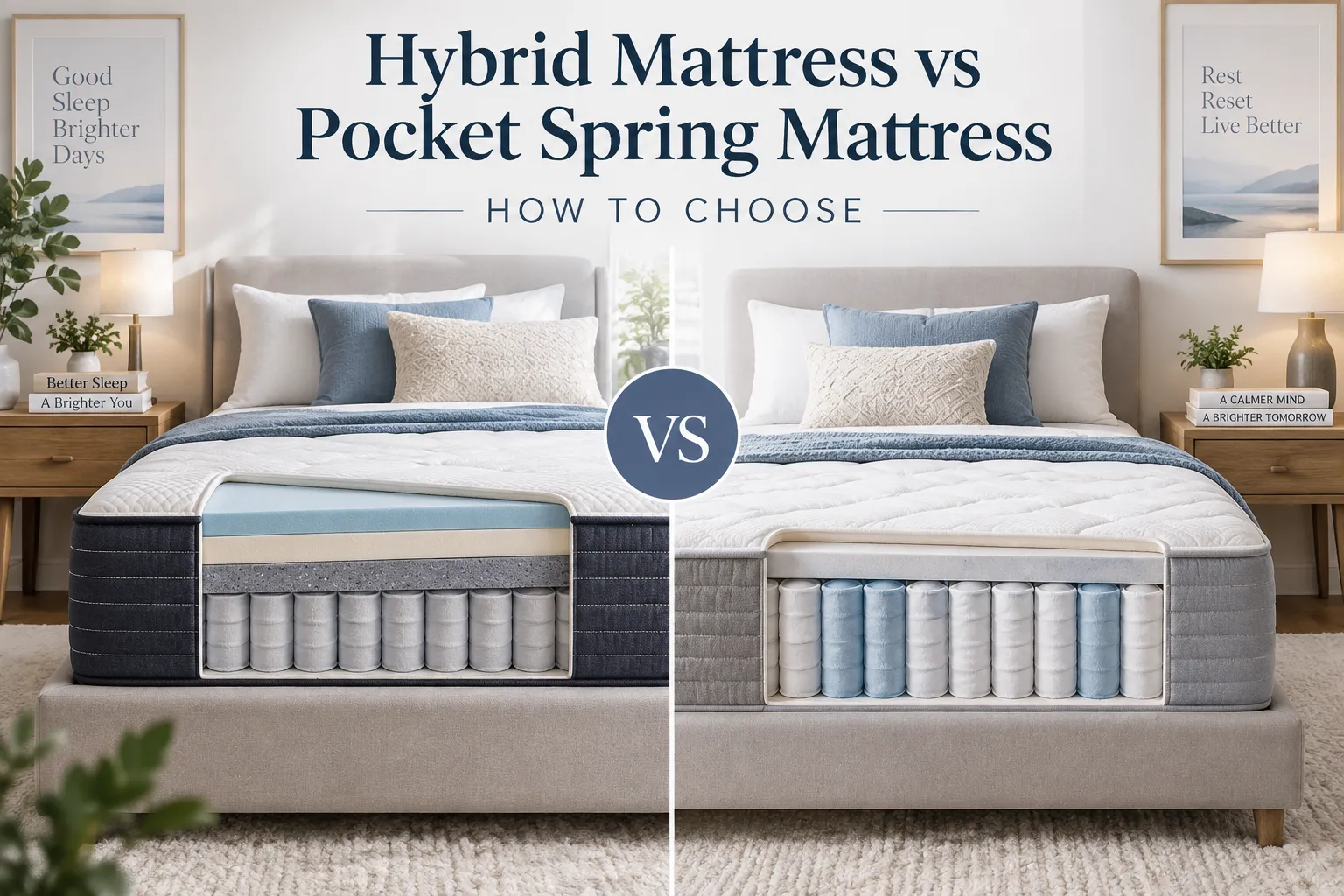
Hybrid mattress ditch that solid foam foundation entirely. They swap it out for a robust system of metal coils. Now, here is where folks get tripped up constantly! On top of those bouncy springs, a hybrid still rocks thick comfort layers made of latex, regular foam, or yes, actual memory foam.
So pitting “memory foam” against “hybrids” is kind of a false rivalry. You are really just choosing between a spring-core or a foam-core base. That hidden bottom section dictates practically everything:
- How much you sweat at night.
- Whether you feel your partner tossing around.
- If getting out of bed requires a forklift.
Hybrid vs Memory Foam at a Glance
Comfort and Feel: Which One Feels Better to Sleep On?

For many shoppers, feel is the deciding factor. A mattress can look great on paper, but if it does not feel right, it will not be the right fit.
- A memory foam mattress usually feels closer, softer, and more body-hugging. It molds around your curves and creates a deeper “sink-in” sensation. Many side sleepers enjoy this cradled feel because it cushions the shoulders and hips.
- A hybrid mattress usually feels more balanced and lifted. The comfort layers still add cushioning, but the coils underneath create more pushback. This makes the bed feel bouncier and less restrictive when you move.
In simple terms, choose memory foam if you like a close, contouring hug. Choose a hybrid if you want comfort without feeling stuck.
Neither feel is better for everyone. The better choice is the one that matches how you like your bed to feel at night.
Cooling and Temperature Regulation

Hybrid mattresses almost always sleep noticeably cooler than memory foam mattresses. It really just comes down to basic airflow. Because a hybrid uses a coiled support core, there is actual breathing room inside the bed. That open space lets your body heat escape rather than just building up under the blankets.
A typical memory foam mattress is incredibly dense. It naturally hoards heat. And since the foam physically wraps around your body, it easily traps warmth right against your skin. To be fair, not all memory foam beds are total sweatboxes these days. Modern setups often utilize copper infusions, cooling gels, or perforated layers to help air circulate.
If you run hot at night, keep these rules in mind:
- Grab a hybrid mattress to play it safe and stay breezy.
- Hunt specifically for advanced cooling tech and lighter comfort layers if you are absolutely determined to buy a memory foam mattress.
Motion Isolation and Partner Disturbance

Sharing a bed is great until your partner starts doing midnight gymnastics. Honestly, this is exactly why motion isolation matters so much. It measures if you will feel every single toss, turn, or late-night bathroom trip.
Memory foam typically destroys the competition here. That thick, dense material swallows kinetic energy whole. It literally absorbs the shockwaves instead of bouncing them across the mattress.
The math backs this up. One massive test showed memory foam scoring an impressively low 4.04 m/s² for motion transfer. Hybrids? They bounced up to 7.40 m/s². Lower is better, making foam the clear winner.
Still, hybrids aren’t entirely hopeless for couples. A setup with individually wrapped coils and a thick foam top can actually mute movement pretty well.
For the insanely light sleepers out there:
- Grab a pure memory foam bed to protect your sanity.
- Hunt for a specialized, motion-isolating hybrid if you really need springs.
Edge Support and Usable Sleep Surface

People constantly underestimate edge support until they slowly slide onto the floor while putting on their socks. A sturdy boundary is actually a massive deal. It dictates whether you can comfortably stretch out across the full width of the mattress without feeling like you are slowly rolling off the side. Plus, it makes getting out of bed in the morning much easier.
Hybrids generally outshine the competition here. Those internal steel springs provide serious structural integrity and a rigid pushback that plain foam just cannot replicate. Traditional memory foam tends to completely cave in the second you put your weight on the corner.
Just look at the exact sinkage stats:
- Memory foam mattress average: 5.21 inches
- Hybrid mattress average: 4.38 inches
Less sinkage equals a dramatically stronger edge. Certain all-foam models definitely try to reinforce their borders to compensate, but coil systems usually still take the trophy.
Pressure Relief, Back Pain, and Spinal Support

Let’s talk about achy joints for a second. Memory foam is practically famous for melting away pressure. It hugs your exact shape, naturally redistributing weight so your hips and shoulders don’t take a massive beating. Side sleepers usually swear by this stuff.
But do not count hybrids out just yet. Honestly, the plush layers stacked on top matter just as much as the springs underneath. A hybrid packed with thick, high-quality foams can easily cradle sore spots while still giving you that satisfying, sturdy pushback from the core.
When it comes to waking up stiff, the actual mattress category isn’t always the main culprit. Proper spinal alignment is the real secret here. Interestingly, a 2023 study pointed out that a medium firmness level actually correlates with reduced back pain (Source). It really just comes down to finding the correct fit for your specific body type.
The Final Checklist
To keep things incredibly simple, just find a bed that does the following:
- Maintains a perfectly neutral spine.
- Stops your pelvis from sinking too deeply into the bed.
- Provides enough soft cushion to keep your shoulders happy.
Ease of Movement, Response Time, and Bounce

How long is this thing actually going to survive? Hybrid mattresses usually steal the spotlight for durability. That heavy-duty coil system does the real heavy lifting, which seriously cuts down on those permanent body craters over time. Pure memory foam mattresses can definitely hang on for a while. Honestly though? All-foam builds just naturally suffer from gradual sagging, especially right under your heaviest pressure points.
Expect a solid hybrid to stick around for roughly 7 to 10 years. Memory foam setups normally tap out a little earlier than that.
But really, longevity isn’t just a basic category contest. It boils down to foam density, coil gauge, your weight, and basic maintenance. A premium foam bed easily outlives a junk hybrid.
Time to replace it if:
- You spot obvious, permanent dips.
- The bed feels weirdly unsupportive.
- You wake up feeling totally wrecked every morning.
Smell, Off-Gassing, and Material Concerns

Ever unboxed a bed and gotten slapped with a weird chemical stink? That is called off-gassing. Memory foam usually catches the bulk of the blame here, since those dense foam blocks release volatile organic compounds (VOCs) right after you tear off the vacuum plastic.
Don’t panic, though. The odor definitely fades. Studies show these emissions spike immediately and then drop off a cliff rather quickly. They rarely hang around long-term. Still, both hybrids and solid foam setups will probably smell a bit initially if they use foam layers.
Want to play it completely safe?
- Hunt down a CertiPUR-US certification tag or a similar low-emission standard.
- Crack open a window to let the room ventilate.
- Give the bed a day or two to breathe before you actually sleep on it.
Price and Overall Value
Budget absolutely matters. Pure memory foam mattress setups typically start cheaper, whereas hybrid mattress demand more cash upfront. Why? They cram complex steel coils and thick foams together into one heavy unit. Currently, a queen foam bed ranges from $800 to $2,500. Queen hybrids generally hover between $1,200 and $2,000.
A steeper price tag never guarantees a superior investment, honestly. Real value depends entirely on your specific nighttime struggles.
- Splurge on a hybrid if you sleep incredibly hot, toss and turn constantly, or desperately need strong borders.
- Grab memory foam for intense body contouring, total silence, and blocking a restless partner’s movements.
Ultimately, the absolute smartest deal is simply whichever bed fixes your exact sleep problems.
Which Mattress Type Is Best for Your Sleep Style?

Picking a winner basically hinges on your specific nighttime annoyances and preferred resting posture.
- Side Sleepers: Memory foam is typically a lifesaver. It perfectly cushions those delicate shoulder and hip joints.
- Back Sleepers: Honestly, either style works. Just ensure the bed actually keeps your spine adequately aligned.
- Stomach Sleepers: Firmness is crucial here. You will probably want a hybrid to stop your pelvis from sinking uncomfortably deep.
- Hot Sleepers: Grab a hybrid. Coils equal airflow, which means less waking up in a puddle of sweat.
- Couples: If feeling your partner twitch drives you insane, pure foam isolates that movement beautifully.
- Heavier sleepers: Hybrids generally take the trophy. Sturdy coil networks simply hold up better under extra weight over the years.
- Budget shoppers: You will likely spot way friendlier starting prices in the all-foam aisle.
The Quick Summary
Boiling it all down is pretty straightforward. Go the foam route for an intense hug, total silence, and absorbing shockwaves. Snag a coil-based bed if you crave a breezier surface, snappy mobility, rigid borders, and a floating sensation.
Ultimately, the universally “perfect” mattress is a total myth. The correct choice is strictly whatever setup actually complements your unique body mechanics.


 English
 Spanish
 Portuguese
 Russian
 Arabic
 Japanese
 Korean
 German
 French
