

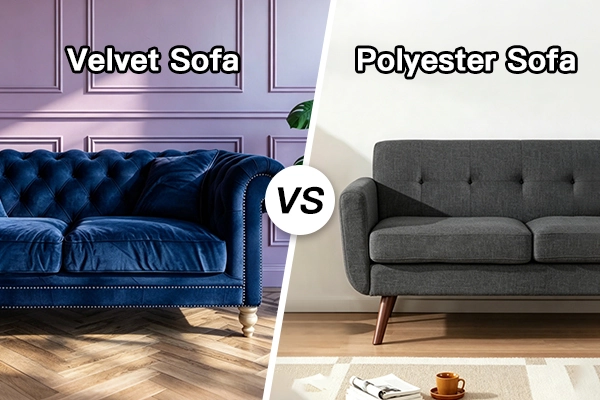
The Great Misconception: Weave Construction vs. Fiber Material
What is Polyester Fabric? (The Synthetic Base)

Let’s be straightforward: standard woven polyester doesn’t try to win beauty contests. Built from petroleum-derived synthetic fibers arranged in a flat-weave or twill structure, it produces a dense, uniform surface that shrugs off everyday spills and holds up surprisingly well under constant friction. Think of it as the reliable workhorse of budget upholstery. Nothing flashy, but genuinely tough and refreshingly easy to maintain.
What is Velvet Fabric? (The Tufted Pile)

Here’s the part where a lot of shoppers get tripped up, and honestly, it makes sense why. Most people assume velvet is a type of fiber. It isn’t. Velvet is actually a weaving technique, where two layers of fabric are constructed face-to-face simultaneously, then sliced apart. That cutting process is what creates the signature soft, upright pile we all recognize. The pile itself? It can be made from cotton, silk, linen, or polyester. The fiber and the construction method are completely separate decisions.
The Ultimate Hybrid: Why Polyester Velvet Dominates

Take polyester fiber. Apply the velvet weaving process. What you get is a performance velvet sofa fabric that pulls off something neither material could manage alone: the luxurious look of velvet with the chemical toughness and stain resistance of a synthetic. That’s not a compromise, it’s actually an upgrade. Worth noting: the vast majority of sofas sold as “velvet” today are already polyester velvet. That’s precisely why they outlast the fragile silk and cotton velvets of earlier decades by such a wide margin.
Durability Showdown: A Manufacturer’s Perspective

Translating Martindale and Wyzenbeek Rub Tests into Years
“50,000 Martindale rub cycles.” Sounds impressive, but what does it actually mean for your living room? Here’s a useful rule of thumb: roughly 3,000 double rubs translates to about one year of regular residential use. So a standard polyester sofa rated at 15,000 rubs will hold up for around five years of daily wear before you start seeing real deterioration. A 50,000-rub performance velvet? You’re looking at closer to 15 years. Commercial-grade fabrics start at 100,000 rubs, which is, for most home settings, essentially a lifetime investment. Always ask for the rub count before you sign anything.
Pilling vs. Pile Crushing: Identifying Real Fabric Damage
Not all wear looks the same, and knowing the difference could save you a costly sofa replacement. Pilling refers to those small, matted fiber clusters that appear on the surface over time. It’s a genuine quality problem, a sign that short-staple, low-grade polyester yarns are breaking down under friction. And unfortunately, once pilling sets in, there’s no reversing it. Pile crushing is a different story entirely. This happens when consistent pressure compresses velvet fibers over time. It looks alarming, but it’s mostly cosmetic. A good velvet brush, or even a light steam held carefully at a safe distance, can bring the pile’s loft right back.
The Pet Owner’s Dilemma: Finding the Best Sofa Fabric for Cats and Dogs

Biomechanics: Why Cats Destroy Woven Polyester but Ignore Velvet
Do cats scratch velvet couches? Few topics in the sofa fabric world generate more conflicting advice than this one, so let’s settle it. Cats scratch to keep their claws conditioned. For that to work, they need a surface with enough structure for their claw tips to grip and drag across. Standard woven polyester is practically designed for this: interlaced yarns give claws something to catch. Performance velvet behaves completely differently. The dense, upright pile has no loops, no woven gaps, nothing for claws to grab onto. The claw simply glances off. That’s why cats typically lose interest in quality velvet couches pretty fast, while they’ll systematically dismantle a woven fabric sofa given half a chance.
The Viral “Rubber Squeegee” Hack for Pet Hair

Are velvet couches hard to clean when you have pets? Not once you know this trick. Even high-quality performance velvet can build up pet hair through static charge over time, and standard vacuum heads often make things worse by pushing the hair deeper into the pile. The solution that took home-care communities by storm is almost embarrassingly simple: a rubber squeegee. Short, firm strokes across the fabric create enough friction to roll embedded hair into neat, removable clumps. A damp rubber glove achieves the same result. If you want a more permanent fix, look specifically for performance velvets that have an anti-static treatment built in at the manufacturing stage.
Spill Management and Advanced Cleaning Protocols
Decoding Upholstery Cleaning Codes (W, S, WS, X)

Somewhere on your sofa, usually stitched onto a tag tucked beneath a cushion, is a manufacturer upholstery cleaning code. Most people never look at it until something goes wrong. By then, the damage is sometimes already done. Wrong products can strip protective coatings or leave permanent stains, so it’s genuinely worth knowing what each letter means:
- W – Water-based cleaner only
- S – Solvent-based cleaner only (water will cause problems here)
- WS – Either water or solvent-based cleaners are safe to use
- X – Vacuum only; no liquids of any kind
Most performance velvet and polyester sofas land on W or WS. Always check the code first, especially before reaching for any product the manufacturer didn’t specifically recommend.
The Hidden Danger of Steam Cleaning Performance Fabrics
Steam cleaning has this reputation as a powerful, chemical-free solution for deep cleaning upholstery. On performance fabrics, though, it can do genuine, permanent harm. Here’s why: high-performance velvets are typically treated with a microscopic hydrophobic coating, the same layer responsible for making liquid spills bead up and roll off rather than soaking in. High-heat steam can melt or degrade that coating, and once it’s gone, it doesn’t come back. The fabric loses its primary line of defense against stains and becomes far more vulnerable. Before pulling out a steam cleaner for any polyester performance sofa, read the manufacturer’s care label carefully and take it seriously.
Allergies, Sun Fading, and Eco-Conscious Choices

Synthetic Fibers as a Hypoallergenic Sofa Fabric: How They Starve Dust Mites
Here’s something that doesn’t come up often enough in sofa shopping conversations: dust mites need ambient moisture to survive and reproduce. Natural fibers like cotton, wool, and linen readily absorb humidity from the surrounding air, creating a cozy little environment that dust mites are perfectly happy to inhabit. Polyester and polyester velvet, by contrast, are inherently hydrophobic. They simply don’t hold moisture. Without it, dust mite populations can’t get established in the fabric at all. This makes synthetic upholstery a genuinely hypoallergenic sofa fabric choice for allergy sufferers. Not a marketing claim, but an actual biological reality backed by how the material behaves.
UV Resistance: Protecting Jewel Tones with Solution-Dyeing
Forest green. Midnight blue. Burnt terracotta. Deep velvet colors are stunning right up until the sun starts having its way with them. The key variable is how the fabric was dyed in the first place. Standard piece-dyeing applies color to the outer surface of already-formed fibers, and UV light can bleach that surface layer over time. Solution-dyed polyester or acrylic works on a fundamentally different principle: the pigment is introduced into the fiber itself during manufacturing, before the fiber has even formed. Color becomes part of the fiber’s structure, not just a surface treatment. UV light simply can’t extract it. If your sofa is going anywhere near a window or a sun-soaked room, solution-dyed fabric isn’t just a nice-to-have. It’s the smart specification to request.
Recycled Polyester (rPET): The Environmental Reality
Performance velvet made from recycled polyester (rPET), spun from post-consumer plastic bottles, has moved well beyond niche status. It’s commercially available, widely accessible, and genuinely practical. The manufacturing process produces meaningfully lower CO₂ emissions compared to virgin polyester production, and it diverts real volumes of plastic waste away from landfills. What often surprises people is that the sustainability story doesn’t come with a performance trade-off. rPET performance velvet routinely hits 100,000+ Martindale rub counts, matching conventional synthetic upholstery across every durability benchmark that matters. For anyone wanting to make an environmentally responsible sofa choice without sacrificing quality, asking specifically for rPET-certified upholstery is a practical, well-supported decision.
Final Verdict: Aligning Fabric Choice with Your Daily Lifestyle

There’s no single “best” sofa fabric. There’s only the right one for how you actually live. A few straightforward pointers to help narrow it down:
- Tight budget, busy household? Standard woven polyester is dependable, durable, and refreshingly low-maintenance.
- Want the luxury look without the high upkeep? A performance velvet sofa gives you everything velvet looks like, with the resilience of a synthetic underneath.
- Allergy concerns? Either polyester option outperforms natural fabrics, simply by denying dust mites the moisture they depend on.
- Pets in the home? Dense-pile performance velvet beats woven fabrics on both fronts: cats can’t scratch it effectively, and pet hair comes off far more easily.
- Sustainability is a priority? Ask your retailer specifically for rPET-certified performance velvet, and request documentation to confirm it.
The old velvet-versus-polyester argument has largely been rendered irrelevant by what modern textile manufacturing can do. Performance polyester velvet isn’t a halfway point between two options. For most real-world households, it’s simply the better fabric.


 English
 Spanish
 Portuguese
 Russian
 Arabic
 Japanese
 Korean
 German
 French
