

Choosing the right mattress firmness is essential for proper spinal alignment, pressure relief, and overall comfort.
The mattress firmness scale—rated from 1 (softest) to 10 (firmest)—helps explain how a mattress feels, but firmness is subjective and depends heavily on your body weight, sleep position, and personal preferences.
While medium-firm (around 6.5) often works for many sleepers, the ideal firmness varies from person to person.
Understanding how each firmness level performs can help you find the right balance of support and comfort for deeper, healthier sleep.
Mattress Firmness Scale (1–10) Explained

The mattress firmness scale is a standardized way to describe how soft or firm a mattress feels.
While most mattresses fall between 3 and 8 on the scale, understanding each level helps you choose the right balance of comfort and support for your body.
Mattress Firmness Chart (Simple Breakdown)
1–2: Extra Soft
Feels extremely plush with deep sinkage. Rare on the market and generally best only for lightweight side sleepers who want maximum contouring.
3–4: Soft
Provides noticeable cushioning and pressure relief, ideal for side sleepers or people under 150 lbs who prefer a “hugging” feel.
5: Medium
Offers a balanced mix of softness and support. Works well for most back sleepers and combination sleepers.
6–7: Medium-Firm
The most popular firmness range. Provides strong support with moderate contouring, suitable for many sleepers—especially back and stomach sleepers.
8–9: Firm
Minimal sinkage with a more supportive, elevated feel. Best for stomach sleepers and heavier individuals who need better hip support.
9–10: Extra Firm
Very rigid with virtually no contouring. Rare and often too firm for most sleepers, but can work for certain heavy or stomach sleepers who need maximum support.
Key Factors That Influence Firmness Perception
Mattress firmness isn’t experienced the same way by everyone.
Your weight, sleeping position, body shape, and even the mattress materials all affect how soft or firm a mattress feels.
Understanding these factors helps you choose a mattress that supports proper spinal alignment and long-term comfort.
Body Weight
Lighter Sleepers (Under ~130 lbs)

Less pressure is applied to the mattress, so it doesn’t compress as deeply.
Result: Most mattresses feel firmer than their rating.
Average-Weight Sleepers (130–230 lbs)

Experience firmness close to how the mattress was designed.
Result: Feel matches the rated firmness.
Heavier Sleepers (Over ~230 lbs)

Sink deeper into the comfort layers.
Result: Mattresses feel softer than their rating and may require firmer support layers.
Weight Distribution Matters
People who carry more weight in the hips or shoulders may experience uneven sinkage, making firmness feel inconsistent across the mattress.
Sleeping Position
Side Sleepers

Shoulders and hips are the main pressure points.
Best Perception: Softer mattresses (3–5) enhance pressure relief.
Back Sleepers

Need balanced cushioning and support.
Best Perception: Medium to medium-firm (5–7) supports the lower back naturally.
Stomach Sleepers

Require firm support to prevent hip sagging.
Best Perception: Firmer mattresses (7–9) maintain spinal alignment.
Combination Sleepers

Move frequently throughout the night.
Best Perception: Medium to medium-firm (5–7), offering ease of movement.
Body Type & Height
Tall Sleepers

Weight is distributed across a larger surface area.
Effect: They may perceive mattresses as slightly firmer.
Shorter Sleepers

Weight is concentrated in a smaller surface area.
Effect: They may sink deeper and perceive mattresses as softer.
Body Shape Matters
- Broad shoulders → need more contouring on top
- Curvier hips → need more support beneath
- Straighter body types → may find firmer mattresses more comfortable
These differences influence how deeply each area compresses the mattress.
Materials & Construction
Memory Foam

Highly contouring and pressure-relieving.
Feels softer, especially under heat and weight.
Latex Foam

More responsive with less sinkage.
Feels firmer and more supportive.
Hybrid Mattresses

Balanced feel combining foam + coils.
Feels medium to medium-firm, depending on coil gauge and foam thickness.
Innerspring Mattresses

More bounce and support, less contour.
Often feel firmer due to thinner comfort layers.
Layer Thickness Changes Everything
Thick comfort layers → softer feel
Thin comfort layers → firmer feel
Transition layers also influence how deeply the sleeper sinks.
Mattress Age & Wear
Mattresses soften over time due to material breakdown.
Foam Mattresses
Gradual softening as the foam cells compress and lose elasticity.
Hybrid or Innerspring Mattresses
May soften unevenly if coils lose tension or comfort layers break down.
Why It Matters
A mattress that once felt medium-firm may feel soft after several years, affecting spinal support and overall comfort.
Choosing the Right Firmness Level (Personalized Guide)
Finding the right firmness level depends on how you sleep, how much you weigh, and whether you experience pressure points or chronic pain.
Use the guide below to match your needs with the firmness range that best supports healthy spinal alignment and all-night comfort.
Choosing Firmness by Sleeping Position
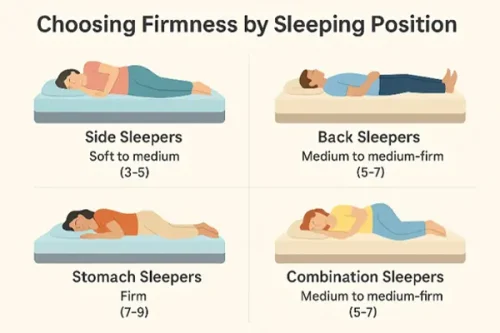
Side Sleepers
Side sleepers place the most pressure on the shoulders and hips.
Best firmness: Soft to medium (3–5)
Why: Offers contouring to reduce shoulder and hip pressure and prevent numbness.
Back Sleepers
Back sleepers need balanced cushioning and support to maintain the spine’s natural “S” curve.
Best firmness: Medium to medium-firm (5–7)
Why: Keeps the lower back supported without letting the hips sink.
Stomach Sleepers
Stomach sleepers need strong support to prevent the hips from dipping, which can strain the lower back.
Best firmness: Firm (7–9)
Why: Elevates the hips and keeps the spine in a neutral line.
Combination Sleepers
Combination sleepers change positions and need a mattress that’s easy to move on.
Best firmness: Medium to medium-firm (5–7)
Why: Offers enough responsiveness and pressure relief for multiple positions.
Choosing Firmness by Body Weight

Under 130 lbs (Lightweight Sleepers)
Lightweight sleepers don’t sink as deeply into the mattress.
Best firmness: Softer levels (3–5)
Why: Maintains proper contouring and prevents feeling “on top” of the mattress.
130–230 lbs (Average-Weight Sleepers)
This group experiences mattresses close to how they’re rated.
Best firmness: Medium to medium-firm (5–7)
Why: Balanced comfort and support for most sleepers.
Over 230 lbs (Heavy Sleepers)
Heavier sleepers sink deeper and need stronger support layers.
Best firmness: Medium-firm to firm (6–9)
Why: Prevents excessive sinkage and keeps the spine aligned.
Choosing Firmness for Pain Relief
Shoulder Pain

Shoulders need room to sink when lying on your side.
Best firmness: Soft to medium (3–5)
Why: Reduces pressure buildup and discomfort during the night.
Back Pain

Back pain is commonly worsened by poor alignment.
Best firmness: Medium-firm (6–7)
Why: Provides the best balance of cushioning and lower-back support.
Hip Pain

Hips are a major pressure point—especially for side and stomach sleepers.
Best firmness: Medium-soft to medium-firm (4–6)
Why: Soft enough for pressure relief, firm enough to support the hips.
Joint Pain / Arthritis

Pressure reduction is the priority.
Best firmness: Soft to medium (3–5)
Why: Cushions sensitive joints while still supporting body weight evenly.
Choosing Firmness for Couples
Sleeping with a partner adds complexity, especially when preferences differ.
Find a Middle Ground
Most couples are comfortable on:
Medium-firm (6–7) — the most versatile firmness level.
Consider Motion Isolation
Memory foam and hybrid mattresses with thicker comfort layers often minimize motion transfer, which can matter more than firmness.
Explore Split Firmness Solutions
For couples with drastically different needs:
- Split king mattresses
- Dual-firmness options
- Adjustable bases
These allow each person to enjoy the feel that works best for them without compromise.
Firmness vs Support: Critical Differences
Many shoppers assume firmness and support are the same, but they describe two completely different qualities.
Understanding the difference is essential for choosing a mattress that keeps your spine aligned and prevents long-term pain.
Firmness = The Initial Feel

Firmness refers to how soft or firm the surface feels when you first lie down.
It’s the immediate sensation—whether the mattress feels plush, medium, or firm.
This is what the 1–10 firmness scale measures.
Firmness is about comfort, not correction.
A mattress can feel soft yet still support you properly, or feel firm but fail to hold your spine in a neutral position.
Support = Spinal Alignment

Support refers to how well a mattress keeps your body aligned, particularly your spine.
A supportive mattress maintains a neutral posture, allowing muscles to relax and pressure points to release.
Why a Soft Mattress Can Be Supportive
- High-quality foams or hybrid designs can provide deep contouring without letting the hips sag.
- Thicker transition layers may prevent the body from sinking too far, even if the surface feels plush.
Why a Firm Mattress Can Be Unsupportive
- If the comfort layers are too thin, the mattress may cause pressure buildup in the shoulders and hips.
- Rigid surfaces can force the spine out of alignment, especially for side sleepers or lightweight individuals.
Support comes from the mattress’s internal structure, not its firmness level.
What True Support Feels Like
Signs of Proper Support
- Your spine feels neutral—no arching or dipping
- You wake without stiffness in the lower back
- Shoulders and hips feel cushioned, not strained
- You don’t roll toward the center of the mattress
- No “hammocking” or sagging sensation
Signs of Poor Support
- Lower-back pain or morning stiffness
- Feeling like your hips sink too deeply
- Pressure points in the shoulders or hips
- Rolling toward your partner or the middle
- Needing pillows to “fix” your posture at night
Bottom line:
Firmness is about comfort.
Support is about healthy alignment.
The best mattress balances both—giving you the feel you prefer with the structure your body needs.


 English
 Spanish
 Portuguese
 Russian
 Arabic
 Japanese
 Korean
 German
 French
