

When choosing a mattress, comfort usually comes first.
But mattress weight is another detail worth paying attention to.
Mattress weight affects how easy it is to move, set up, rotate, and whether your bed frame can properly support it.

Mattress weight varies widely based on size, materials, and construction.
A small foam mattress may be easy to lift, while a large hybrid or latex mattress can be extremely heavy.
Knowing how much a mattress weighs ahead of time helps you avoid setup issues and choose a mattress that fits both your home and your lifestyle.
Average mattress weight: quick overview

On average, a mattress can weigh anywhere from 40 pounds to over 180 pounds.
Lightweight options, like twin-size foam or air mattresses, sit at the lower end.
At the other extreme, king-size hybrid and latex mattresses are often the heaviest due to dense materials and coil systems.
Most queen mattresses fall somewhere in the middle, but even then, weight can vary widely.
Many people assume a mattress in a box is lighter, but that’s not always true.
Boxed mattresses are compressed for shipping, not made with fewer materials.
Once unboxed, a thick foam or hybrid mattress can weigh just as much as a traditional one.
Several factors influence mattress weight:
- Mattress size: larger sizes add significant weight
- Materials: latex and coils weigh more than basic foams
- Construction: extra layers and reinforcements increase heft
- Thickness: taller mattresses usually mean more weight
Understanding these basics makes it easier to compare options and avoid surprises when it’s time to move or set up your mattress.
Does mattress weight really matter?

Yes, mattress weight does matter, just not for comfort.
It affects how easy the mattress is to handle and whether your setup can support it.
Moving and setup are the biggest issues.
Heavy mattresses are harder to lift, carry, and place on a bed frame.
Large hybrid or latex mattresses usually need two people, especially in tight spaces or upstairs rooms.
Bed frame support is also important.
Every frame and base has a weight limit.
A mattress that’s too heavy can cause slats to bend, sag, or break over time.
Weight also affects rotating or flipping.
Regular rotation helps a mattress wear evenly, but doing this alone is much harder with a heavy mattress.
If you use an adjustable base, weight matters even more.
Heavier mattresses can strain the motor, while split mattresses are easier to manage because each side is lighter.
In short, mattress weight won’t change how it feels, but it can make a big difference in daily use and long-term convenience.
Mattress weight by type
Different mattress types can feel similar to sleep on, yet weigh very differently.
The materials inside make the biggest difference.
Here’s a clear breakdown of how mattress weight compares by type.
Memory foam mattresses

A queen-size memory foam mattress usually weighs between 60 and 100 pounds.
Most all-foam mattresses are lighter than hybrids, but some can still surprise you.
The key factor here is foam density, not firmness.
A mattress can feel soft but still be heavy if it uses dense foam layers.
Thicker designs with multiple comfort layers or solid foam cores often weigh more than expected.
Innerspring mattresses

Traditional innerspring mattresses tend to be lighter than most modern designs.
A queen size often falls between 60 and 90 pounds.
Their weight depends mainly on the coil system. Fewer coils and thinner gauge steel keep weight down.
Since innerspring mattresses usually have less foam and more open space inside, they’re easier to move than hybrids or latex models.
Hybrid mattresses

Hybrid mattresses are usually the heaviest category.
A queen hybrid commonly weighs 90 to 130 pounds, and king sizes can go much higher.
That extra weight comes from combining steel coils, thick foam layers, and added edge support.
Reinforcements designed to improve durability and support also add mass.
This is why hybrids often require two people to move.
Latex mattresses

Latex mattresses are among the heaviest mattresses available.
A queen-size latex mattress often weighs 120 pounds or more.
Natural latex is heavier than synthetic latex, and the production method matters too.
Dunlop latex is denser and heavier, while Talalay latex is lighter due to its airier structure.
Even so, most latex mattresses are heavy because latex is naturally dense.
Airbeds and specialty designs

Airbeds are the lightest option, often weighing 20 to 50 pounds depending on size and features.
Since most of the support comes from air chambers, there’s far less solid material inside.
Some specialty designs use modular or adjustable components, but these are less common.
While airbeds are easy to move, they’re usually not meant for long-term everyday use.
Understanding these differences makes it easier to predict how heavy a mattress will be before it arrives at your door.
Mattress weight by size
Mattress size has a major impact on how much it weighs.
Even when made from the same materials, larger mattresses can be dramatically heavier.
Below are typical mattress weight ranges by size, keeping construction differences in mind.
Twin

A twin mattress usually weighs between 40 and 50 pounds.
This makes it easy to move and lift on your own.
Twin mattresses are often used for kids’ rooms, bunk beds, and small spaces where handling weight matters.
Twin XL

A twin XL mattress is slightly longer than a twin and typically weighs 45 to 55 pounds.
The extra length adds some weight, but it’s still manageable for one person in most cases.
Full

A full-size mattress often weighs 50 to 70 pounds.
It offers more sleeping space than a twin without becoming too difficult to move, which makes it a popular choice for single sleepers and guest rooms.
Queen

A queen mattress is where weight increases sharply.
Most queen mattresses weigh between 90 and 160 pounds, depending on materials and thickness.
Many people are surprised by how heavy a queen mattress can be, especially in hybrid or latex designs.
King

A king-size mattress typically weighs 120 to 180 pounds.
These mattresses are large, bulky, and hard to move without help.
They usually require a sturdy bed frame and at least two people for setup.
California king

A California king mattress has a similar weight range to a standard king, usually 120 to 180 pounds.
While it’s narrower and longer, the overall surface area is close enough that weight differences are minimal.
Knowing the weight by size helps you plan for delivery, setup, and whether your current bed frame can handle the load.
Mattress thickness and construction

Mattress thickness has a direct effect on weight.
Most mattresses are between 6 and 14 inches thick.
Thinner mattresses use fewer materials, so they’re lighter and easier to move.
Thicker mattresses have more layers, which makes them heavier.
Each extra layer adds weight, especially when it includes dense foam, latex, or coils.
Added comfort layers, reinforced edges, and thicker support cores all increase the overall weight.
This is why luxury and high-profile mattresses are much heavier.
Many are 12 inches or taller and use multiple layers for comfort and support, which makes them harder to lift and handle.
Thickness also affects bed frame support.
Heavier mattresses need a strong base or closely spaced slats.
A weak or older frame may sag or get damaged over time, so it’s important to make sure your foundation can handle the weight.
Split mattresses and modular designs

Split mattresses make large beds easier to handle.
A split king or split California king comes as two separate pieces, usually twin XL size, so each side is much lighter.
This design makes moving and setup easier, especially in tight spaces like hallways or stairs. In many cases, one person can carry each section.
Split mattresses also pair well with adjustable bases.
Each side moves on its own, letting partners adjust their position without disturbing the other.
For large beds, split designs offer a simpler and more practical setup.
Does a mattress gain weight over time?

Yes, a mattress can gain a small amount of weight as it ages.
Over time, it may collect dust and moisture from everyday use, which adds a bit of extra weight.
In most cases, this change is minor and not noticeable when lifting or moving the mattress.
It doesn’t affect comfort or performance.
Using a mattress protector, washing bedding regularly, and keeping good airflow in the room can help reduce buildup and keep the mattress clean.
Is a heavier mattress better?

A heavier mattress isn’t always better.
Mattress weight doesn’t determine comfort.
How a mattress feels depends more on its materials and support than on how much it weighs.
Heavier mattresses can be a good choice if they use dense foam, coils, or latex, which often feel more stable and support higher weight limits.
They also work well with strong bed frames.
Lighter mattresses make more sense if you move often, have limited space, or plan to rotate the mattress yourself.
They’re easier to handle and less demanding on bed frames.
In the end, choose comfort and support first, then pick a weight that fits your space and setup.
How to choose the right mattress weight for you
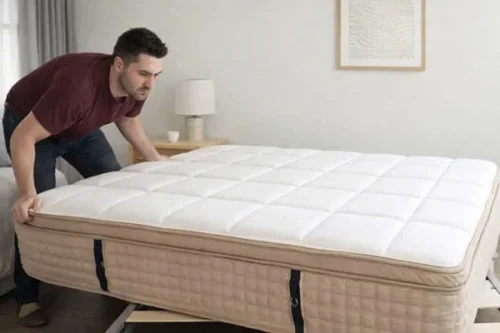
Choosing the right mattress weight comes down to how you live and how you plan to use it.
These simple factors can help narrow things down.
- Based on your living situation
If you live in an apartment, walk-up building, or have narrow hallways and stairs, a lighter mattress is usually easier to deal with. Larger homes with ground-floor bedrooms can handle heavier mattresses with fewer issues. - Based on your bed frame or base
Always check your bed frame or adjustable base limits. Heavier mattresses need strong slats or a solid foundation. If your frame is lightweight or older, a lighter mattress can help prevent sagging or damage. - Based on your ability to move or rotate
If you plan to rotate your mattress yourself, weight matters. Lighter mattresses are easier to lift and turn, while heavier ones often require help. Split mattresses can be a good option if you want a large bed without the full weight in one piece. - Based on long-term plans
If you move often or like to rearrange your space, a lighter mattress can save time and effort. Heavier mattresses are better suited for long-term setups where frequent moving isn’t expected.
Thinking through these points makes it easier to choose a mattress that fits your lifestyle, not just your sleep preferences.


 English
 Spanish
 Portuguese
 Russian
 Arabic
 Japanese
 Korean
 German
 French
