


Why Daybeds Don’t Usually Need a Boxspring

Daybeds don’t usually need a boxspring because they are designed with built-in support systems—such as slats, link springs, or solid platforms—that are meant to support the mattress directly. Adding a boxspring raises the mattress too high, which can make the daybed uncomfortable to use as a sofa and disrupt its intended dual function. The extra height can also interfere with trundle beds or under-bed storage, both of which are common daybed features. In addition, the added weight of a boxspring may strain the frame, since most daybeds are not engineered to support both a mattress and a boxspring together.
What Supports the Mattress Instead of a Boxspring

Instead of a boxspring, most daybeds rely on built-in support systems designed specifically for their frame and function. Common options include link spring foundations, often found in metal daybeds, which use a wire grid attached to the frame to provide firm, even support. Other daybeds use wooden or metal slats, typically spaced closely enough to support the mattress without sagging. Some designs feature a solid platform base, which offers a flat, stable surface similar to a platform bed. All of these support systems are intended to replace a traditional boxspring, providing proper mattress support while maintaining the correct height and functionality of the daybed.
When a Boxspring Might Be Used on a Daybed (Rare Cases)

In rare situations, a boxspring may be used on a daybed if the frame is a traditional or open-frame design that does not include built-in support such as slats, a link spring, or a solid platform. This is more common with antique, Victorian, or wrought-iron daybeds, which were sometimes designed to function like standard bed frames and rely on a boxspring to properly support the mattress and absorb weight. In these cases, a boxspring can help prevent mattress sagging and improve stability. However, because designs vary widely, it’s important to check the manufacturer’s guidelines or frame specifications before using a boxspring to ensure compatibility and safety.
What to Use Instead of a Boxspring
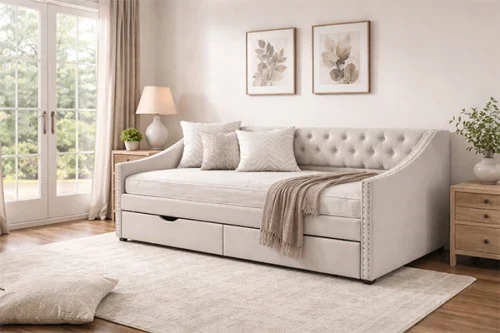
Instead of a boxspring, the mattress is typically placed directly on the daybed’s built-in support system, such as slats, a link spring, or a solid platform. For mattresses that require a firmer, more even surface—such as memory foam or latex mattresses—a thin bunkie board can be added on top of the frame for extra support. A bunkie board provides the needed stability without significantly increasing the overall height of the mattress, helping the daybed maintain its comfort, appearance, and intended function as both a sofa and a bed.
Final Verdict

Most modern daybeds do not use boxsprings because they are designed with built-in support systems that adequately support the mattress on their own. These supports maintain the correct height, stability, and functionality of the daybed, making a boxspring unnecessary and often impractical. Boxsprings are only suitable in rare, frame-specific situations, such as certain traditional or open-frame daybeds that lack built-in support, and should be used only when the frame is designed to accommodate one.


 English
 Spanish
 Portuguese
 Russian
 Arabic
 Japanese
 Korean
 German
 French
