

A memory foam mattress usually lasts about 7–10 years, which is the short answer most people are looking for.
If you’re asking this question, you’re probably already noticing soreness or poorer sleep than before.
That lifespan can vary quite a bit depending on foam quality, how often the mattress is used, your body weight, and how well it’s been cared for.

In this guide, I’ll walk you through what really affects longevity, how to spot early signs of wear, and when replacing your mattress actually makes sense.
How Long Does a Memory Foam Mattress Last?

In most homes, a memory foam mattress lasts around 7–10 years, and that’s assuming normal daily use.
I know that range can feel a little vague, but it’s actually realistic.
Memory foam tends to hold up better than traditional innerspring mattresses because it doesn’t rely on metal coils that can bend or break over time.
Instead, the foam slowly compresses and loses resilience, which usually happens more gradually.
That said, not all memory foam is created equal.
Higher-quality or premium memory foam mattresses can sometimes push past the 10-year mark, especially if they use denser foam and a solid support core.
I’ve seen well-made foam mattresses still feel supportive after a decade, while others start sagging way sooner.
On the flip side, lower-quality memory foam often breaks down faster.
Cheaper foam tends to soften quickly, develop body impressions, and lose support in as little as 4–6 years.
If a mattress feels comfortable at first but loses its shape fast, lifespan is usually the reason.
What Affects the Lifespan of a Memory Foam Mattress?

If you’ve ever wondered why one memory foam mattress lasts a decade while another gives up way sooner, this is where the answer usually is.
From what I’ve seen, lifespan comes down to a handful of very practical factors, not marketing claims or brand hype.
Foam Density and Material Quality
This is a big one. Foam density matters more than the brand name on the label.
Low-density memory foam tends to feel soft and comfortable at first, but it breaks down faster and forms impressions sooner.
Medium-density foam usually hits a better balance, while high-density memory foam holds its shape longer and resists sagging, which directly improves long-term support.
In simple terms, denser foam ages more slowly.
Mattress Construction and Thickness
How a mattress is built also plays a huge role.
The support core does most of the heavy lifting, while the comfort layers handle pressure relief.
If the support layer is thin or weak, the mattress won’t age well.
One-sided mattresses are more common today, but flippable mattresses can last longer because wear is spread out.
Edge support matters too—weak edges tend to break down first.
Body Weight and Sleep Position
Your body puts real stress on foam over time.
Heavier sleepers usually see faster wear, especially around the hips and shoulders.
Couples also tend to wear mattresses unevenly.
Sleep position matters too—side sleepers compress foam more in pressure points, while back and stomach sleepers spread weight more evenly.
Frequency of Use
A mattress used every night ages faster than one in a guest room.
That’s just reality. Occasional-use mattresses often last longer simply because they’re not under constant pressure.
Temperature, Humidity, and Environment
Memory foam is sensitive to heat and moisture.
Warmer, humid rooms can speed up foam breakdown over time.
Good airflow and a breathable setup help prevent moisture buildup, which quietly shortens lifespan.
Foundation and Bed Frame Support
Even a great mattress won’t last on a bad base.
Slatted frames need proper spacing, and solid platforms need to be sturdy.
Poor support underneath can cause sagging no matter how good the foam is, and I’ve seen that mistake cut years off a mattress’s life.
Signs Your Memory Foam Mattress Is Reaching the End of Its Lifespan

Sometimes a mattress doesn’t fail all at once—it just slowly stops doing its job.
I’ve ignored these signs before and paid for it with weeks of bad sleep, so this section really matters.
If you’re noticing one or more of the issues below, your mattress is probably nearing the end.
- Permanent sagging and deep body impressions
Small impressions are normal, but if the foam doesn’t bounce back and you can clearly see dips where you sleep, the foam has lost its structure. - Loss of support and pressure relief
When memory foam wears out, it stops supporting your spine evenly. That “floating” feeling turns into sinking without support. - Waking up with aches, pains, or stiffness
New back, hip, or shoulder pain—especially in the morning—is a common red flag that the mattress isn’t doing its job anymore. - Increased tossing and turning
If you’re constantly shifting to find a comfortable spot, the foam is likely worn unevenly. - Sleeping better on other mattresses
This one’s surprisingly telling. If you sleep better at a hotel or a friend’s house, your mattress is probably the problem. - Excess heat retention over time
Older foam tends to trap more heat as airflow decreases, even if the mattress used to sleep cool. - Persistent odors from moisture or bacteria
Smells that won’t go away can mean moisture buildup inside the foam, which also shortens lifespan. - Allergy or skin irritation symptoms
Aging mattresses can collect dust mites, allergens, and bacteria that trigger itching, congestion, or breakouts. - Mattress age exceeding 7–10 years
Even if it looks okay, age alone can be enough. Materials naturally break down over time.
If several of these sound familiar, it’s usually a sign that replacing the mattress will improve your sleep more than trying to “make it work” a little longer.
How to Extend the Life of a Memory Foam Mattress
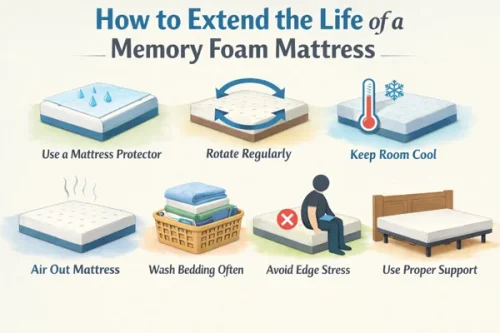
If you want to get the full lifespan out of a memory foam mattress, a little care goes a long way.
None of this is complicated, but skipping the basics can easily shave years off a mattress’s life—I’ve learned that the hard way.
- Use a breathable, waterproof mattress protector
This is probably the easiest win. A good protector keeps sweat, spills, and dust from soaking into the foam, which helps prevent odor, bacteria, and early breakdown. Breathability matters, so avoid anything that feels like plastic. - Rotate the mattress regularly
I usually recommend rotating it head-to-foot every 3–6 months. This spreads out wear and helps prevent deep impressions from forming in the same spots. - Maintain a stable bedroom temperature
Memory foam doesn’t love extreme heat. Keeping your room at a consistent, moderate temperature helps the foam hold its shape longer and sleep more comfortably. - Air out the mattress occasionally
Every few months, strip the bed and let the mattress breathe for a few hours. Good airflow helps reduce moisture buildup inside the foam. - Wash bedding frequently
Clean sheets aren’t just nicer to sleep on—they reduce oils, sweat, and allergens that can sink into the mattress over time. - Avoid jumping or sitting heavily on the edges
Memory foam isn’t designed for concentrated pressure. Sitting on the edge every day or letting kids jump on the bed can break down foam faster. - Ensure proper bed frame and center support
A weak or poorly spaced frame can cause sagging no matter how good the mattress is. Proper support underneath makes a real difference in how long the mattress lasts.
Taken together, these habits won’t make a mattress last forever, but they can help you get every year you’re supposed to out of it—without overthinking things.
Memory Foam vs Other Mattress Types: Lifespan Comparison
If you’re deciding whether memory foam is a good long-term option, a side-by-side comparison makes things much clearer.
Different mattress types wear out in different ways, and lifespan isn’t just about years—it’s about how they break down.
Which Mattress Type Lasts the Longest?

In general, latex mattresses last the longest, followed by memory foam, then hybrids, with innerspring mattresses coming in last.
Memory foam sits in a sweet spot—it lasts noticeably longer than innerspring mattresses without the higher price tag of latex.
For a lot of people, that balance of lifespan, comfort, and cost is exactly why memory foam remains such a popular choice.
Is It Worth Replacing an Old Memory Foam Mattress?

In most cases, yes—it’s worth replacing an old memory foam mattress.
Once the foam starts losing support, sleep quality usually drops fast.
Waking up sore, tossing and turning more, or sleeping better on other beds are all signs the mattress isn’t doing its job anymore.
If your mattress is already 7–10 years old, age alone can be enough reason to move on.
Over time, memory foam traps more heat, holds allergens, and stops responding to your body the way it used to.
From my experience, upgrading an aging mattress is often one of the quickest ways to improve sleep without overcomplicating things.


 English
 Spanish
 Portuguese
 Russian
 Arabic
 Japanese
 Korean
 German
 French
