


Why Memory Foam Mattresses Feel Too Soft

Memory foam mattresses often feel too soft because the material reacts strongly to heat, pressure, and moisture.
- Heat from your body or a warm room softens memory foam, making it sink more.
- Body weight and repeated pressure compress the foam over time, reducing firmness.
- Humidity and trapped moisture can weaken foam structure and make it feel less supportive.
In some cases, a mattress is simply designed to be plush.
In others, it becomes softer as materials wear down.
Either way, excessive softness usually means the mattress isn’t providing enough support, especially for your lower back and hips.
Quick Ways to Make a Memory Foam Mattress Firmer

If you want fast results without replacing your mattress, start here.
These methods are simple, practical, and commonly recommended, and we’ll explain each one in detail later.
- Add a firm mattress topper to create a more supportive sleep surface
- Improve mattress support by checking your bed frame, slats, or foundation
- Lower the bedroom temperature to prevent memory foam from softening overnight
- Reduce moisture buildup that can weaken foam materials over time
- Reinforce the base with a bunkie board or other solid support layer
These options work for different reasons, and some are more effective than others depending on why your mattress feels too soft.
Best & Safest Ways to Firm Up a Memory Foam Mattress

These methods are effective, low-risk, and safe for most memory foam mattresses.
Use a Firm Mattress Topper (Best Overall Option)
A firm mattress topper is the easiest and most reliable way to improve firmness.
It adds surface support without changing the mattress itself.
Latex toppers tend to feel firmer and more responsive, while high-density memory foam resists sinking better than standard foam.
A thickness of 2–3 inches is usually enough.
This works well if the mattress feels soft on top but isn’t deeply sagging. If there are deep body impressions, a topper won’t fully fix the issue.
Fix the Support Under Your Mattress
Softness often comes from poor support, not the mattress.
Memory foam needs a flat, rigid base.
Platform beds work best.
Slatted frames are fine if slats are no more than 3 inches apart.
Old or sagging box springs often reduce firmness and should be replaced.
Improving the foundation can make a noticeable difference, sometimes more than changing the mattress surface.
Lower Room Temperature to Increase Firmness
Memory foam softens in heat and firms up when it’s cool.
Keeping your bedroom around 65–68°F (18–20°C) can make the mattress feel firmer right away.
This is a quick, free fix, though the effect is temporary and depends on room temperature.
Reduce Moisture That Softens Memory Foam
Moisture from sweat or humidity can weaken foam over time.
Occasionally airing out the mattress, improving airflow, and using a breathable mattress protector can help prevent further softening.
This won’t dramatically firm up a mattress overnight, but it supports long-term firmness.
Methods That Work — But Have Risks
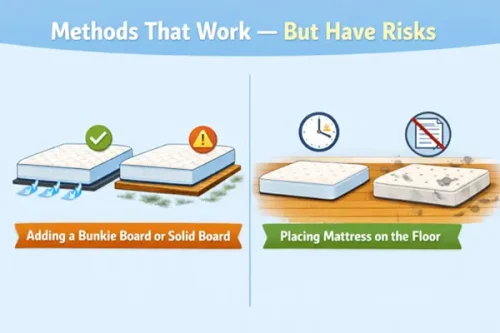
These methods can increase firmness, but they come with downsides and should be used carefully.
Adding a Bunkie Board or Solid Board
A bunkie board or solid board under the mattress removes flex and makes the bed feel firmer.
Bunkie boards are safer because they’re designed for mattresses and allow some airflow.
Solid boards like plywood can block ventilation, increasing the risk of mold, and may void the mattress warranty if not approved by the manufacturer.
Placing a Mattress on the Floor (Short-Term Only)
Sleeping with a mattress on the floor often feels firmer because there’s no give underneath.
However, it reduces airflow, traps moisture, collects dust, and may void warranties.
This is best used only as a temporary test, not a long-term solution.
Methods That Usually Don’t Work Well

Some fixes sound helpful but rarely solve softness problems.
Thin mattress pads don’t add real support.
Cheap or low-density toppers compress quickly and often make sinking worse.
Flipping most memory foam mattresses doesn’t work because they’re usually one-sided.
Trying to “break in” an already soft mattress only makes it softer, not firmer.
If a method doesn’t improve support, it won’t fix the problem.
Should You Flip or Rotate a Memory Foam Mattress?
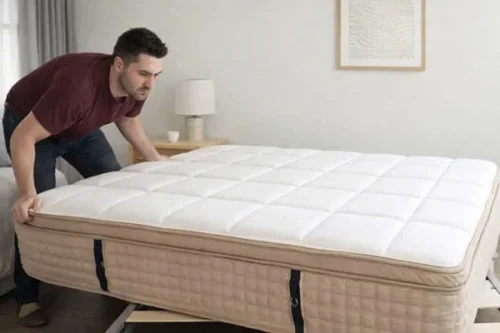
Most memory foam mattresses should not be flipped.
They’re built with a specific layer order, and flipping them can cause discomfort or damage.
Rotating the mattress (head to foot) every 3–6 months can help distribute wear and slow down soft spots.
However, rotation won’t restore firmness once the foam has broken down—it’s preventive, not corrective.
How Firm Should Your Mattress Actually Be?
There’s no single “perfect” firmness, but there is a firmness level that works better for your body and how you sleep.
The goal is enough support to keep your spine aligned without making the mattress feel hard or uncomfortable.
A Simple Firmness Scale

Mattress firmness is usually rated on a 1–10 scale:
- 1–3: Very soft, deep sinking
- 4–6: Medium to medium-firm
- 7–10: Firm to extra firm
Most people fall somewhere in the middle of this range.
Best Firmness by Sleeping Position and Body Weight
Your sleeping position matters more than most people realize.
- Side sleepers usually need a slightly softer surface so the shoulders and hips can sink in comfortably. Lighter side sleepers often prefer medium, while heavier side sleepers do better with medium-firm.
- Back sleepers need balanced support to keep the lower back from sagging. For most, medium-firm works best.
- Stomach sleepers generally need a firmer mattress to prevent the hips from sinking too deeply and pulling the spine out of alignment.
Body weight also plays a role. Heavier sleepers put more pressure on the mattress and typically need more firmness to avoid excessive sinking.
Why Medium-Firm Works for Most People
A medium-firm mattress provides the best balance of comfort and support for the widest range of sleepers.
It allows light contouring for pressure relief while still keeping the spine in a neutral position.
That’s why medium-firm mattresses are often recommended for general comfort and back support.
When Firmer Is the Better Choice
A firmer mattress is usually a better option if you:
- Sleep on your stomach
- Sleep mostly on your back
- Feel your hips sinking too deeply
- Wake up with lower back pain
If your current mattress feels too soft, increasing firmness can improve support even if you don’t want an “extra-firm” feel.
When Firming a Mattress Is No Longer the Safe Option

In some cases, trying to firm up a memory foam mattress is no longer effective or safe.
If the mattress has deep sagging, permanent body impressions, or no longer rebounds when pressure is removed, the internal foam has broken down.
Adding toppers, boards, or other fixes won’t restore proper support and may even worsen comfort.
Age also matters. Most memory foam mattresses last 7–10 years.
If yours is near or beyond that range and feels unsupportive, firmness adjustments are unlikely to help.
Before forcing a fix, check your warranty or sleep trial.
Some manufacturers cover excessive sagging, and continuing to modify a failing mattress can void that coverage.
When the core support is gone, replacing the mattress is often the safest way to protect your spine and sleep quality.


 English
 Spanish
 Portuguese
 Russian
 Arabic
 Japanese
 Korean
 German
 French
